Showing posts with label History of Photography - ART 380. Show all posts

Thursday, May 6, 2010

women photographers


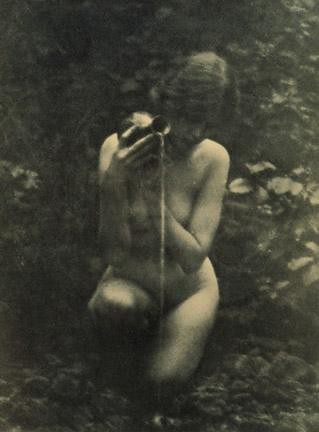
Anne W. Brigman, “The Source”, 1906, gelatin silver film interpositive, 11.9 x 8.4 cm., The Oakland Museum Collection also printed in Camera Work, Vol. 25, 1909

I find this one interesting because it look like it would be a statue or make a great statue. But for the life of me, it feels like this may already be a statue or there is one similar and perhaps that Anne Brigman is recreating that in a photograph. It has a soft and graceful feel to it. It also seems as though it should be a painting too. It is just too intriguing for words.

Family of Man


"CHILDBIRTH" BY WAYNE MILLER IN 1946

This photo makes me think of life, how families are made, becoming a father or mother, and growing up. "The Family of Man" is a great title for a show with this photograph in it; that title has so many different meanings that it just fits perfectly.

photography in the atomic age


"Child in Forest" (1951)


Wynn Bullock


These two photographs by Wynn Bullock are interesting because the present nature in an interesting way. I'm not even a huge nature fan either. The one in our book, "Child in Forest," I like because the see of clovers or something that is just covering the ground ever so beautifully makes it look like the girl is in a sea that just so happens to be of green plants.

Knowing the World through reproductive media


Photo-journalism as art


Joe Rosenthal
"Raising the American flag at Iwo Jima" (1911)


V.J. Day, 1945
Alfred Eisenstaedt

These are two infamous pictures that any American should not forget. It seems that some of the great photo-journalist photographs that end up famous are one of some kind of military member for force acting as a honorable citizen. Photos like these help Americans remember what it mean to be American and to show their American pride. As art these photos have great composition and great tonal range. They are using the rule of thirds, which is always a great rule to use to produce a great and interesting photo of almost anything, no matter the subject or subject matter. These two pictures will always be famous and will always have it place in history, not just photographic history.

Nabbing Time


"Kids Dancing"
Helen Levitt, 1940

This one is so cute! The kids are dancing in the street just having a great time and not even worrying about anything else, which is the way it should be for kids their age. You can tell that Helen Levitt was just anticipating a moment like this one from these two adorable children. She certainly captured them in the moment and acting like two imaginative kids. I like how they are dancing and acting like no one is watching and not even caring about it, which is a great that they allowed Levitt to "nab" this because it is like they forgot she was even there.

Social Documents


"The Sky-boy"
Lewis W. Hine

This one scared me just because he has no protection for he were to have fallen. It is not like he is only a couple of inches from the ground, no he is thousands of feet in the air. He is only on a rope type line and that is it. I fear for his life when I look at this picture, but because of that it drew me in and became interesting to me. It make me wonder How did Lewis W. Hine capture this photo?

Cliche Vere


Cliche verre, a Greek phrase meaning “glass picture. Cliche Verre is a method of etching on a ground-coated transparent material, or painting and drawing on a transparent surface, such as glass or film and printing the resulting image on a light sensitive paper. Cliche verre was one of the earliest forms of reproducing images before the advent of the camera. During the mid 19th century, French landscape painter Jean-Baptiste Camille Corot made the cliche verre a popular combination of art and photography. It is a process first practiced by a number of French painters during the early part of the 19th century.

sources: Wikipedia.com and Photography.com

Cyanotype project ideas

I have a few interest photos that I have taken for some of my photo classes. I'm thinking that they would turn out to make interesting and great looking cyanotypes. The photos I'm thinking of are already interesting enough by themselves.


Hannah Hoch- Collage


This particular one interested me because first off it is pink. Secondly, because it has a large head on top of some ballerina's legs. I use to do ballet and loved it so I of course might be a reason that it intrigued me. Thirdly, the scaling is off on the face an eye is a little larger than the other so it looks like it has been manipulated in that way as well. It certainly is a new approach to collage, it seems almost cubist like.

Man with a Movie Camera


This is interesting because of the effects that are used. The little man on top seems like something that could not be done yet at such an early time in movie film making. It is also a great way that the film starts out. I really like it when you are just look at the camera for a second and then another second you see the little man climbing out of it, it is really neat!

A Trip to the Moon


This one I like because the fact that they put the woman sitting on the moon is funny, like that is really possible. This also got me thinking that this maybe the idea of where DreamWorks productions got part of their signature "logo" in the begging of their films where there is a young boy who floats up to sit and rest on the half moon. It is also interesting too see the stars and moon interpreted like that.

Early Lumiere Films


Here are a few Lumiere short films. My favorite is the one of the train arriving at the train station. It is so interesting too see how the train carts worked back then. Each person had their own door to get on the train instead of just one or two entrances for each cart. The flow and the smoothness is a little shocking for it to be the first films created. I am utterly impressed!

Photography and Moderism


Picasso, Pablo. Woman Playing the Mandolin (1909) State Museum of New Western Art, Moscow, 1931.


I think cubist painters help to show things in much more abstract way that people had never seen before, this help to seen thing in a different way. People started to perhaps see a part of something instead of the whole thing/object. It help photographers to shoot photos in a different manner as well like maybe getting closer in on the object. It helped Dada artists with seeing art in a "new light" and coming up with unconventional ideas of art which also caused controversy.

Pictorialism and Naturalism


A. L. Coburn, Williamsburg Bridge (1909)


GEORGE DAVISON
REFLECTIONS (1899)


These photos fit because pictorialism and naturalism is about drama and that is shown by the sharpness, tonality, texture and even manipulation of the photo. Providing the most optical photo possible and showing almost exact replicas of the real objects they photographed. The tonality of the contrast seems to help bring an extreme dramatic effect. Naturalism seems to do the same but is more about landscapes, nature, and showing naturalistic qualities.

Wednesday, May 5, 2010

Picture from Campus


This picture is located on the 3rd floor of the CSC in the Duncan's Lounge. This photo is interesting because the men have their outfits on backwards. It make you wonder how did they all do that. I knew that people had a sense of humor back then but it is just something that people never actually think about when they think of people from the past. It certainly, seems like a thing that Mercerians would think of to do. I enjoy the old darkroom look that this photo has to it. It is mysterious because it keeps me wondering who the men are and what do they look like. It could be some student's great-great-grandfather and they would have no idea because you can't see their faces.

My Cyanotypes


Friday, April 30, 2010

Technical breakthroughs


Top: "The Great Train Robbery" 1903
Moving Picture
Edwin S. Porter

Bottom: Charles Corbet
Young lady with fan on a couch
c. 1910
autochrome

Well with the help of Edward Muybridge, he helped open new doors so moving pictures like "The Great Train Robbery" to be made. Edwin S. Porter has done the same for the predecessors that followed after him. Because of these men we are able to have movies today. It shows a great advancement in 3 dimensional photography and moving space. Everything isn't stereo anymore. Advances in color photography helps to see the world as it really is, in living color. This is a huge step for photography from photography's past. People were able to see photography in a "new light".

Edward Muybridge


Untitled
1879
Edward Muybridge

This one is interesting because you can see the progression of the man jumping the hurdles. You can also see the muscles that are used for this activity. I'm sure this photo came in handy for athletes to follow in this sport, it taught them the proper way to jump hurdle. I had no idea that this sport has been around for that long even. Without this photo to document that no one these day may not have known.

Sunday, March 14, 2010

Civil War


Confederate dead behind the stone wall of Marye's Heights, Fredericksburg, Virginia, killed during the Battle of Chancellorsville, May 1863


These photos are some of the hardest to see. It was too dangerous for photographers to be in the field with the war in progress. They had no choice but to take pictures of what had already happened and, unfortunately, it was not a good turn out. There are a few taken of men relaxing in the fields waiting for action. It would always take so long to set up for even just one picture that it hindered them from taking picture also as the action happened as well. Not to mention the exposure time was much longer so it was hard to get true civil war action.